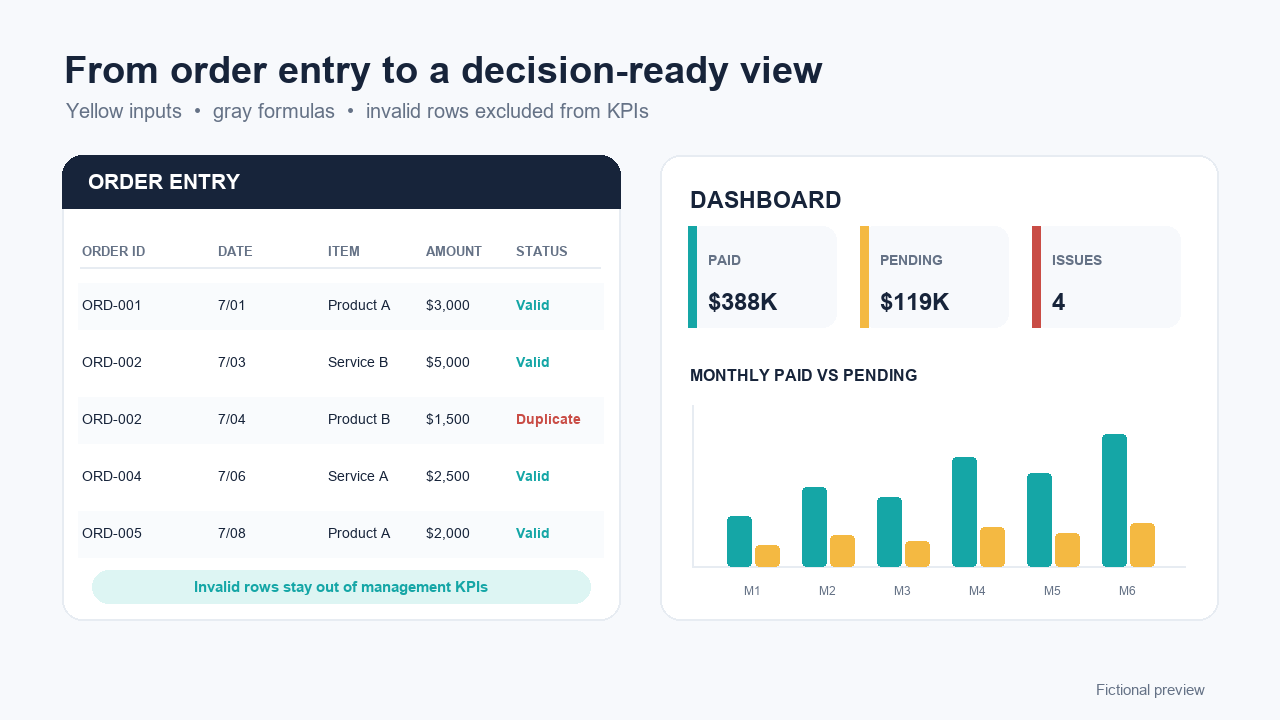
This is implementation leverage—not automated consulting.
The pack saves repeated foundation work: a 500-row blank workbook, a 120-order fictional demonstration, a client deployment register, commercial terms, a proposal-and-scope template, an 18-item handoff checklist, quick start, changelog, and manifest.
You still own discovery, permissions, field mapping, substantive customization, formula validation, backups, training, acceptance, billing, tax, privacy, security, and first-line support. A working dashboard does not prove the client's source records are complete or correct.
Use one repeatable seven-step client workflow.
- Confirm the receipt tierConsultant permits one external client organization; Partner permits up to five. A used deployment cannot move to another client.
- Write the scope before touching dataDefine inputs, outputs, delivery, revision limits, acceptance, exclusions, price, and first-line support.
- Preserve the original workbookKeep the blank source unchanged and create a separate working copy for each licensed client.
- Minimize client dataUse a non-identifying client code in the register. Do not collect passwords, OTPs, card data, or identifiers the workflow does not need.
- Configure and testUse five to ten fictional or de-identified rows to cover normal, duplicate, missing, invalid, paid, pending, cancelled, and overdue cases.
- Train and hand offDemonstrate entry, correction, backup, and recovery; deliver the version, instructions, backup location, and support deadline.
- Record acceptanceComplete the 18 handoff checks and record the client code, version, handoff date, and acceptance evidence.
Choose by deployment count—not by promised outcome.
| Tier | Price | External clients | Delivery |
|---|---|---|---|
| Consultant | US$99 | Up to 1 organization | Same nine-file English commercial pack |
| Partner | US$299 | Up to 5 organizations | Same nine-file English commercial pack |
Each separately contracted or billed organization that receives a customized copy consumes one deployment. Fixes and backups for that same client do not consume another deployment; a used deployment cannot move to a new client.
What commercial use permits—and what it does not.
You may charge for discovery, configuration, substantive customization, testing, training, handoff, and maintenance for licensed clients. You may deliver the customized copy for that client's internal use.
Do not sell the original or modified files as a template, publish them, sublicense them, add them to a course or membership library, or give a client redistribution rights. This is not PLR or MRR.
Know when a workbook is the wrong implementation.
A single-file workflow can fit one named file owner, low-frequency collaboration, a clear source table, and a process the client can test and back up. Stop and clarify scope when the client needs concurrent multi-user editing, granular permissions, a complete audit trail, APIs, automated bank reconciliation, invoicing, accounting, inventory, or regulated-data controls.
Structured references with Excel Tables · Apply data validation to cells · PivotTables and PivotCharts overview
Frequently asked questions
Can I sell the workbook itself to a client?
No. The commercial license permits a customized copy to be delivered within substantive discovery, configuration, testing, training, and handoff work. It does not permit standalone resale, sublicensing, marketplace uploads, or redistribution of the original, blank, or modified template.
What counts as one client deployment?
Each separately contracted or billed external organization that receives a customized copy consumes one deployment. Fixes, backups, and minor revisions for that same organization do not consume another deployment. A used deployment cannot be transferred to a new client.
Do Consultant and Partner receive different files?
They receive the same English commercial implementation pack. The receipt tier controls whether the buyer may deploy to one or up to five external client organizations.
Does the register technically stop copying?
No. The register and receipt document capacity; they are not technical access controls. The buyer remains responsible for following the purchased deployment limit.
When should I refuse a spreadsheet implementation?
Stop and clarify scope when the client needs concurrent multi-user editing, granular permissions, a complete audit trail, APIs, automatic bank reconciliation, invoicing, accounting, inventory, or regulated-data controls. Those needs may require a dedicated system.